Legal Framework: Title 5 of the United States Code
Federal holidays in the United States are officially established by Congress under Title 5 of the United States Code (5 U.S.C. § 6103). While federal law strictly governs non-essential federal government agencies and federal employees, these dates serve as the national benchmark for state governments, financial institutions (Federal Reserve banks), stock exchanges (NYSE/NASDAQ), and corporate workplaces across the country.
The 11 Recognized Federal Holidays
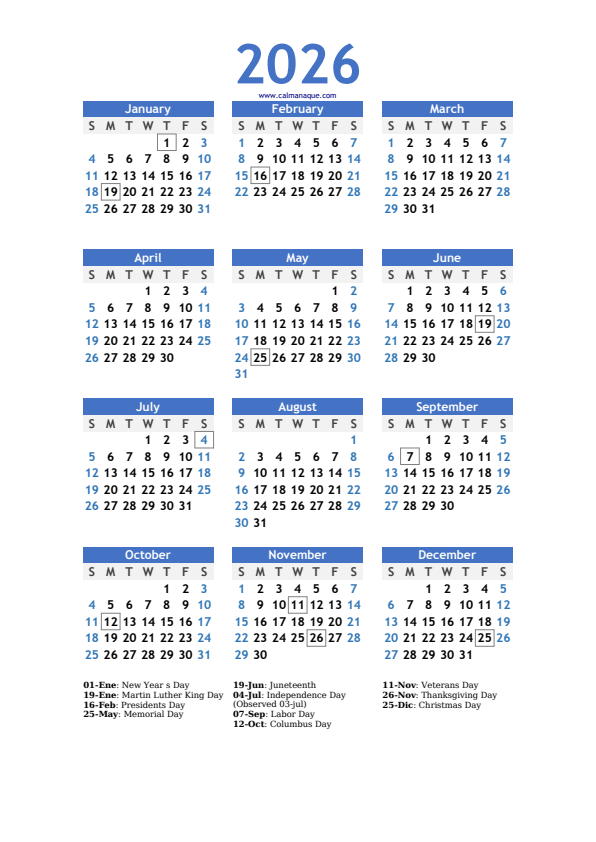
The United States designates eleven annual federal holidays: New Year's Day, Martin Luther King Jr. Day, Washington's Birthday (commonly celebrated as Presidents' Day), Memorial Day, Juneteenth National Independence Day, Independence Day, Labor Day, Columbus Day (observed in various states as Indigenous Peoples' Day), Veterans Day, Thanksgiving Day, and Christmas Day.
The Uniform Monday Holiday Act & In-Lieu Observances
To provide workers with extended three-day weekends, the Uniform Monday Holiday Act of 1968 relocated several public observances to designated Mondays (MLK Day on the third Monday in January, Presidents' Day on the third Monday in February, Memorial Day on the last Monday in May, Labor Day on the first Monday in September, and Columbus Day on the second Monday in October). Furthermore, under federal observance rules, when a calendar holiday falls on a Saturday, government offices and financial markets observe it on the preceding Friday. When a holiday falls on a Sunday, the statutory observance shifts to the following Monday.
Printable Vector Specifications
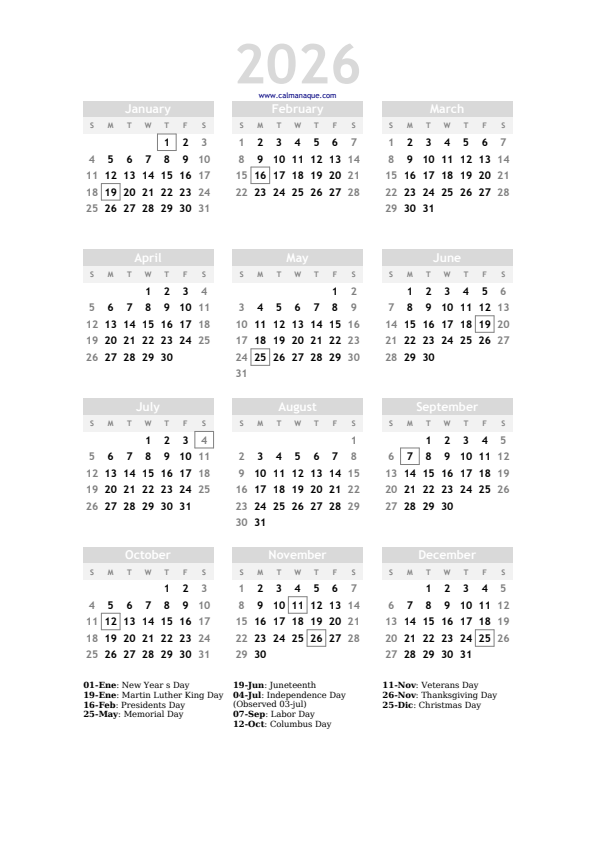
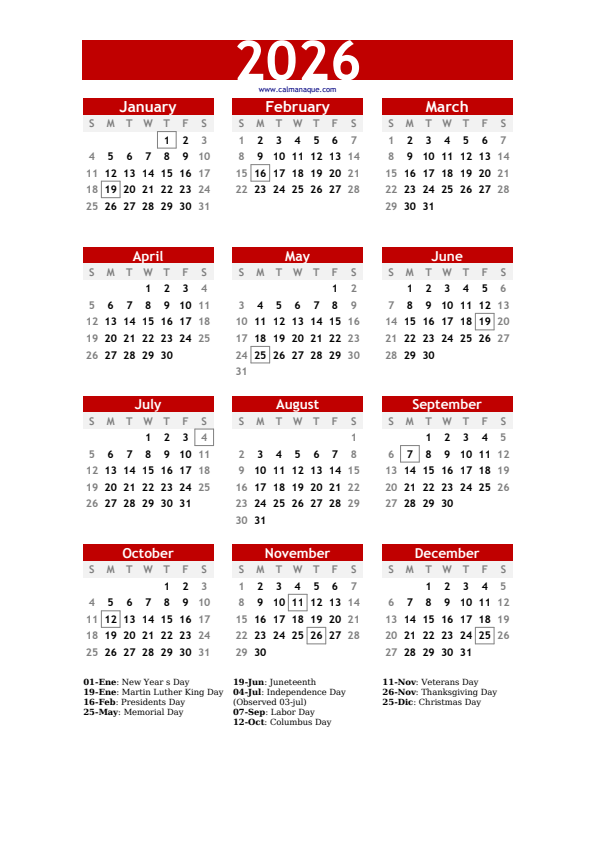
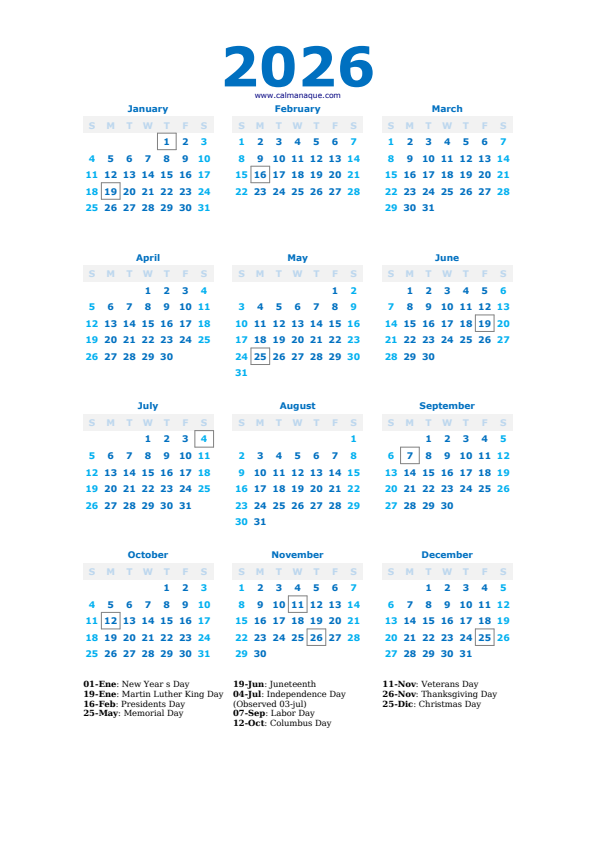
Our 2026 printable calendars for the United States are crafted specifically for standard North American Letter size paper (8.5 × 11 inches). Rendered as scalable vector PDF files, they ensure razor-sharp typography at any magnification while using minimalist line weights engineered to minimize toner and inkjet cartridge usage.